
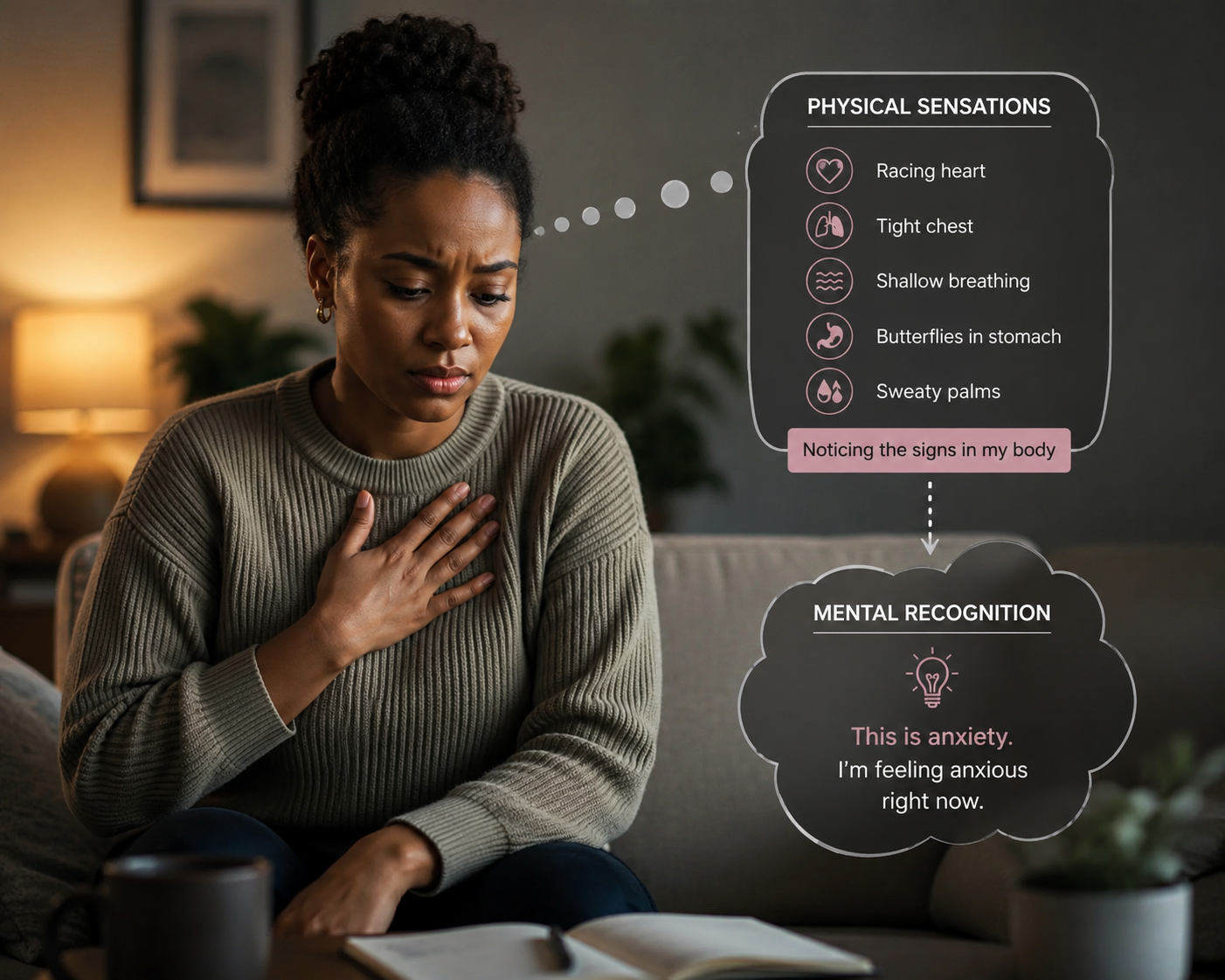
Physical Symptoms of Anxiety Your Body Noticed Long Before Your Brain Did
Your body had been trying to tell you something for months. You just did not know how to read it yet.
For many people, the physical symptoms of anxiety arrive long before any conscious recognition of distress. The tight chest before a difficult conversation. The stomach that turns over on Sunday evenings for no obvious reason. The jaw you discover, at 11pm, has been clenched since morning. These sensations feel physical because they are but they are also emotional, carrying information your nervous system registered before your thinking mind caught up. Learning to recognize physical symptoms of anxiety as communication, rather than random malfunction, changes the way you understand your own experience entirely.
The Body as an Early Warning System
The human nervous system evolved to detect threat long before language existed. Your brain stem and limbic system, the older and fastest parts of your brain process danger signals and trigger a physical stress response in milliseconds. Your prefrontal cortex, the part responsible for rational thought and self-reflection, moves considerably slower. This means your body genuinely does know first. It responds to stress, danger, and emotional overwhelm before y ou have formed a single conscious thought about the situation.
This is not a design flaw. For most of human history, it kept people alive. The problem, in modern life, is that the same system activates in response to an overflowing inbox, a difficult relationship, or a looming deadline and the physical response arrives without a clear label attached to it.
Physical Symptoms of Anxiety That Often Go Unrecognized
Most people recognize a panic attack as anxiety. Far fewer recognize the subtler, chronic physical symptoms of anxiety that accumulate quietly over weeks and months without ever announcing themselves clearly.
Persistent muscle tension, particularly across the shoulders, neck, and jaw, is one of the most common. Many people carry this tension so habitually that they only notice it when someone points it out, or when the resulting headache becomes impossible to ignore. Chronic tension of this kind often reflects a nervous system that has been on low-level alert for a long time.
Digestive disturbances are another frequently overlooked signal. The gut contains an extensive network of neurons, sometimes called the second brain and it communicates directly with the brain through the vagus nerve. Anxiety disrupts this system reliably, producing nausea, bloating, urgency, or a persistent unsettled feeling in the stomach that has no obvious dietary cause.
Fatigue is also widely misread. Many people experiencing anxiety expect to feel wound up and restless. Instead, they feel exhausted because running a chronic stress response requires enormous energy. The body works hard to maintain this state of readiness, and the result is a tiredness that sleep does not fully resolve.
Other signals include heart palpitations, shallow breathing, skin flare-ups, frequent illness due to immune suppression, dizziness, and a general sense of physical unease that resists easy explanation. Taken individually, any one of these might seem minor. Together, they describe a body under sustained pressure.
Why the Brain Takes Longer to Catch Up
There are several reasons why people recognize physical symptoms of anxiety in their bodies long before they name them emotionally. Some of these reasons are neurological, and some are cultural.
Neurologically, emotional awareness requires access to the prefrontal cortex; the part of the brain that interprets, contextualizes, and labels experience. Under stress, blood flow and neural activity shift toward the more reactive parts of the brain, which means the very cognitive capacity needed to identify anxiety often becomes less available precisely when anxiety is highest. The body is already responding to something the thinking brain cannot yet articulate.
Culturally, many people grow up in environments that discourage emotional recognition, either through explicit messages about toughness or simply through a lack of emotional vocabulary modelled in the home. When you have never been taught to name feelings, you learn instead to live in your body’s reactions to them without ever connecting the two.
The Science Behind Somatic Anxiety
Researcher and psychiatrist Bessel van der Kolk spent decades studying how stress and trauma register in the body, and his work fundamentally shifted the conversation about anxiety and mental health. His central argument is that the body encodes emotional experience as physical sensation, and that healing requires working with the body directly not just the mind.
This is not a fringe position. Somatic anxiety responses are well documented across clinical literature. The polyvagal theory, developed by neuroscientist Stephen Porges, maps how the autonomic nervous system moves between states of safety, mobilization, and shutdown each state producing a distinct and recognizable set of physical experiences. Anxiety, in this framework, is a nervous system state as much as a mental one.
Understanding this reframes the experience considerably. Your tight chest is not just tension. Your exhaustion is not laziness. Your stomach is not simply sensitive. These are your nervous system communicating in the only language it had available before you learned to listen more carefully.
What Listening to Your Body Actually Requires
Tuning into physical symptoms of anxiety as information requires a practice that does not come naturally to most people particularly those who have spent years overriding or dismissing bodily signals in order to keep functioning.
Somatic awareness, at its simplest, means pausing to notice what is happening in your body before reaching for an explanation or a solution. It means asking not just ‘what am I thinking’ but ‘what am I feeling physically, and where?’ Practices like body scanning, breathwork, yoga, and somatic therapy all work by strengthening the connection between physical sensation and emotional awareness rebuilding a channel of communication that stress and disconnection tend to erode.
This kind of attention is not passive. It takes real effort to slow down enough to hear what the body is saying, especially in a culture that rewards constant output and treats rest as unproductive. But the information available in physical sensation is genuinely valuable, and ignoring it tends to cost more over time than attending to it early.
When Physical Symptoms of Anxiety Deserve Professional Support
Recognizing somatic anxiety signals is useful, but it does not replace professional care. If you experience persistent physical symptoms without a clear medical cause like chronic fatigue, digestive issues, recurring muscle pain, or frequent illness, it is worth raising these with both a doctor and a mental health professional. The two conversations belong together, not in separate silos.
Anxiety that has lived in the body for a long time often needs more than cognitive insight to shift. Somatic therapies, EMDR, and nervous system regulation work can reach places that talk therapy alone sometimes cannot. This is not a weakness in the approach, it is an acknowledgment that the body holds experience in ways that thought alone cannot always access.
Your Body Was Never the Problem
Perhaps the most important reframe available here is this: your body was not betraying you when it produced these symptoms. It was doing exactly what bodies do, responding to pressure, signalling distress, and trying to protect you with the tools it had. The symptoms were not random. They were not weakness. They were communication.
The brain eventually catches up. And when you finally connect the tight chest to the relationship that has been draining you for months, or the exhaustion to the grief you have been pushing aside something important becomes possible. Not instant resolution, but honest recognition. And recognition, as anyone who has sat with their own body long enough to really listen will tell you, turns out to be a surprisingly powerful place to start.

Temitayo Olawunmi
Temitayo Olawunmi is a clinical psychologist in service to Arogi Trauma Care Foundation. She is solution-focused and result-driven. She has a strong passion for delivering exceptional customer service and ensuring clients satisfaction at every touchpoint.