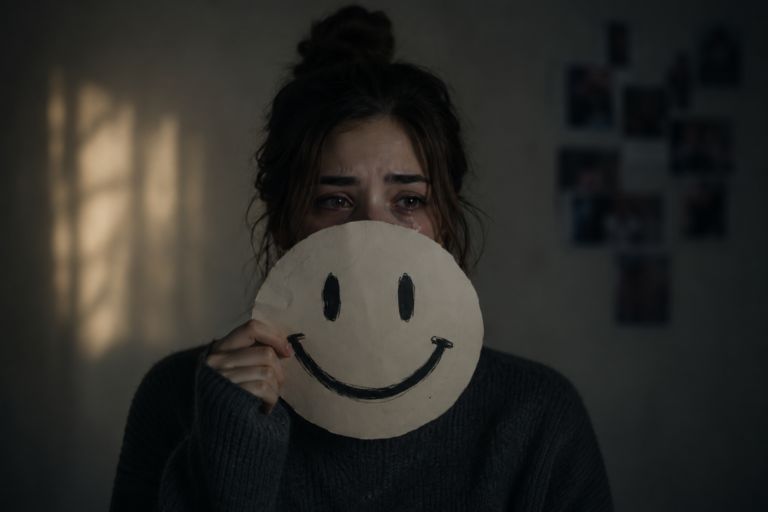

Non-Linear Healing Process: The Painful Truth About Why Recovery Never Looks the Way You Expect
“There is no sun without shadow, and it is essential to know the night.” – Albert Camus
The non-linear healing process is perhaps the most disorienting and least discussed reality of psychological recovery. You do the work. You attend the sessions, read the books, practise the tools, and for a stretch of time things genuinely improve. Then, without warning, a difficult week arrives that feels worse than anything you experienced before you started. Old feelings resurface. Old patterns flicker back to life. And the thought that follows becomes quiet, insidious, and remarkably convincing that you have failed, regressed, or that healing was never really happening at all.
That thought is wrong. And understanding why it is wrong may be the single most important thing you can learn about the recovery journey
Why the Non-Linear Healing Process Feels Like Going Backwards
Human beings are pattern-seeking creatures, and the pattern most people unconsciously apply to healing is a straight upward line, a steady, measurable, progressive improvement from pain toward wholeness. This expectation is reasonable. It is also, according to decades of psychological research, almost entirely inaccurate.
Psychologist James Prochaska’s Transtheoretical Model of behaviour change, this is one of the most widely referenced frameworks in clinical psychology, it describes recovery not as a linear sequence but as a spiral. People move through stages of change, but they also cycle back through earlier stages before advancing again. Prochaska’s research found that most people make several genuine attempts at lasting change before it consolidates, and that returning to an earlier stage is a statistically normal part of the process rather than an aberration.
Furthermore, neuroscientist and trauma researcher Bessel van der Kolk explains that trauma and deep emotional pain are stored not just cognitively but somatically in the body’s tissues, nervous system responses, and implicit memory. Healing these layers does not happen in a single, smooth arc. Different layers surface at different times, often triggered by new life circumstances, relationships, or sensory cues that reach depths previous work had not yet touched. What feels like regression is frequently the healing process reaching a new and deeper layer of the wound.
The Window of Tolerance and Why Bad Days Are Not Backward Steps
One of the most useful frameworks for understanding the non-linear healing process comes from psychiatrist Dan Siegel’s concept of the window of tolerance, the optimal zone of nervous system arousal within which a person can process difficult experiences without becoming overwhelmed or shutting down completely.
As healing progresses, that window gradually widens. A person who once became dysregulated by a mildly stressful conversation develops the capacity to remain present through increasingly difficult ones. However, this widening does not happen uniformly. The nervous system expands, then contracts, then expands again often in response to external stressors, sleep disruption, relational triggers, or simply the accumulation of daily demands.
A bad day during recovery, therefore, does not mean the window has closed. It means the nervous system is responding to current conditions, just as it always has. The difference often invisible from the inside is that the baseline from which it contracts is higher than it was before. You are not back at the beginning. You are temporarily below your new ceiling, which is not the same thing at all.
What Non-Linear Healing Actually Looks Like in Real Life
The non-linear healing process rarely announces its setbacks dramatically. More often, it surfaces in quieter, more confusing ways, a week of unusual irritability, a return of anxious thoughts that had been absent for months, an unexpected grief that arrives without obvious cause, a withdrawal from people and activities that had recently brought genuine pleasure.
These experiences feel like failure because the cultural narrative around healing strongly implies that progress should be visible, consistent, and cumulative. Therapy should make you progressively calmer. Grief should steadily diminish. Trauma work should produce a measurable before-and-after. When reality contradicts that narrative, when the grief spikes again, when the anxiety returns, when the old thought patterns flicker back to life, the gap between expectation and experience generates its own secondary pain.
Psychologist Susan David describes this gap as one of the most common sources of unnecessary suffering in recovery: not the original pain itself, but the judgment that the pain should no longer be there. The belief that you should be further along by now that the stumble represents a loss of ground rather than a natural feature of uneven terrain adds a layer of shame and discouragement that the healing process itself does not require.
Reframing Setbacks Within the Non-Linear Healing Journey
Reframing setbacks as information rather than verdicts is not spiritual bypassing or toxic positivity. It is an accurate reading of what the research actually shows about how psychological change works. Every difficult period within the non-linear healing process carries data about which wounds still need attention, which nervous system responses still need rewiring, which beliefs still operate below the level of conscious awareness.
Psychologist and author Russ Harris, drawing on Acceptance and Commitment Therapy, describes psychological flexibility as the capacity to move toward what matters even in the presence of difficult thoughts and feelings, not after they disappear, not despite them, but alongside them. This framework fundamentally reorients the goal of healing. The aim is not to arrive at a place where difficult experiences no longer occur. The aim is to build the internal capacity to move through them with greater ease, greater awareness, and greater compassion for yourself each time they do.
Additionally, tracking progress across a longer timeframe consistently interrupts the distortion that setbacks produce. Comparing today’s difficult week to last year’s difficult week rather than to last month’s better week often reveals a trajectory of genuine growth that the short view entirely obscures. The non-linear healing process looks chaotic from inside a single bad day. Viewed across months or years, a different and far more encouraging pattern tends to emerge.
You Have Not Lost the Ground You Gained
The non-linear healing process asks something genuinely difficult of the people living through it: the willingness to keep going when going feels like circling back, to trust progress that does not look like progress, and to extend to themselves the patience they would readily offer anyone else navigating something hard.
Albert Camus understood that knowing the night is not the opposite of reaching the light, it is the necessary condition for it. The shadow does not cancel the sun. It confirms that the sun exists and that you are moving in its direction, even on the days when the path curves so sharply that the light temporarily disappears from view.
You have not lost the ground you gained. You are simply on a path that bends and every path that bends eventually straightens again.

Temitayo Olawunmi
Temitayo Olawunmi is a clinical psychologist in service to Arogi Trauma Care Foundation. She is solution-focused and result-driven. She has a strong passion for delivering exceptional customer service and ensuring clients satisfaction at every touchpoint.